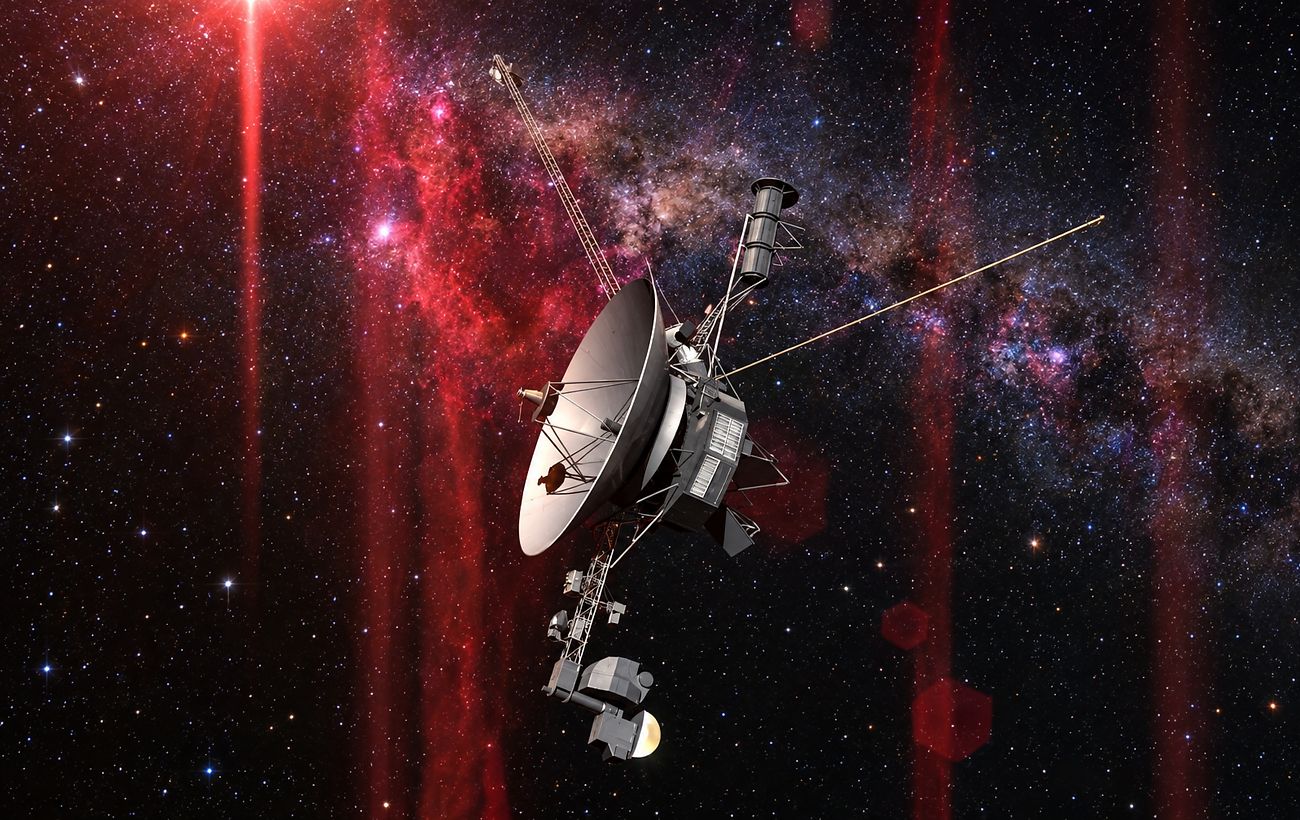
Spacecraft Voyager 1 reaches distance of one light-day from Earth
NASA's Voyager 1 spacecraft has set a historical milestone by moving one light-day away from Earth.
 💡Tech
Photo: RBC-Ukraine
Key points
- Voyager 1 is now one light-day away from Earth
- The distance exceeds 25 billion kilometers
- Both probes were launched by NASA in 1977
- Engineers continue to optimize power for extended missions
The legendary Voyager 1 spacecraft has reached another incredible milestone in its long journey. The distance between the probe and our planet now exceeds 25 billion kilometers, which is equivalent to a 24-hour journey for a radio signal. To mark this historical milestone, NASA specialists have prepared special events for space enthusiasts, including the opportunity to send symbolic signals into the sky using Morse code.
Interestingly, the two twin probes, launched in the late 1970s, follow different trajectories. Although Voyager 2 started two weeks earlier, its counterpart eventually pulled ahead. Engineers at the US space agency planned the routes to address different scientific goals by utilizing gravitational maneuvers near the giant planets of the Solar System.
Due to trajectory specifics and the study of Neptune's moon Triton, Voyager 2 lost some speed compared to its partner. Nevertheless, both spacecraft crossed the boundaries of the heliosphere long ago and continue to explore interstellar space, demonstrating the fantastic reliability of technology built nearly half a century ago.
Despite the depletion of nuclear power sources, engineers at the Jet Propulsion Laboratory continue to maintain contact with the stations. Thanks to power optimization and the shutdown of non-critical instruments, there are realistic chances that the pioneers of deep space will continue transmitting data to Earth into the next decade.
This achievement highlights the remarkable endurance of human engineering and long-term scientific planning. As both spacecraft venture further into the unknown, they provide invaluable data about interstellar space while continuing to inspire future generations of scientists and engineers worldwide.
Source RBC-Ukraine — rbc.ua/ukr/news/voyager-1-vidletiv-svitloviy-den-vid-zemli-17950032… ↗
Read next
 🇺🇦Ukraine
Slovak Minister Blames Ukrainians for 1968 Prague Spring Crackdown: Facts and Rebuttal
Slovak Foreign Minister Juraj Blanár claimed that Ukrainians were behind the 1968 Soviet invasion of Czechoslovakia, sparking backlash and historical corrections.
 💼Economy
Military engineers to be involved in energy infrastructure restoration
The government plans to engage State Special Transport Service specialists to assist with repair works on energy facilities damaged by shelling.
 👥Society
Europe Records a Significant Population Recovery of Rare Giant Birds
Ornithologists have counted 638 great bustards in a protected area in Slovakia, marking the best result in over fifty years.
 🛡️Security
Russian corvette 'Mercury' destroyed in Libya
A Russian missile corvette 'Mercury' was destroyed and partially sank following a powerful explosion at the port of Benghazi.
 🎭Culture & Sport
Iconic director Quentin Tarantino welcomes third child
Renowned American filmmaker Quentin Tarantino and his wife Daniella Pick have welcomed their third child together.
 🎓Education
Scientists find a way to grow potatoes in simulated lunar soil
Researchers successfully grew potatoes with tubers in a substrate mimicking lunar regolith using organic fertilizers.