AI Discovers Critical Java Vulnerability: Global and Local Infrastructure at Risk
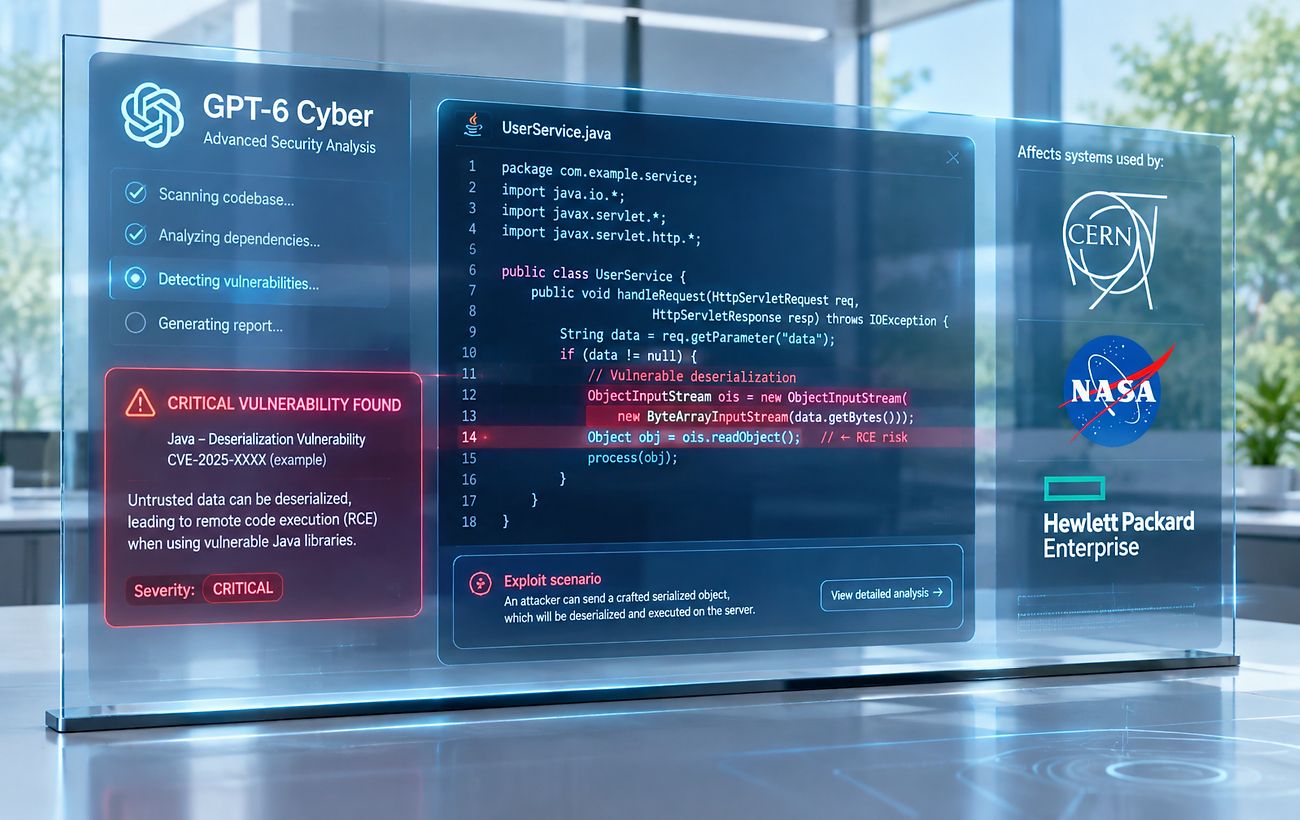
The GPT-6 Cyber AI model has identified a dangerous flaw in Java, potentially allowing hackers to seize control of systems at NASA and thousands of other organizations.
 💡Tech
Photo: RBC-Ukraine
Key points
- GPT-6 Cyber AI identified a critical flaw in Java's base64 decoder.
- The vulnerability affects Keycloak, used by NASA, CERN, and major corporations.
- Oracle has issued a patch, but legacy systems remain vulnerable for years.
A specialized AI model, GPT-6 Cyber by OpenAI, has uncovered a critical vulnerability in the Java programming language, which powers approximately 90% of Fortune 500 companies. The flaw, dubbed 'Java4Shell,' was found during an analysis of the base64 decoder—a standard tool used to convert binary data into text format. Security researcher Kwang Luong, utilizing AI, determined that under specific conditions, the system incorrectly processes certain character sequences, opening a backdoor for cyberattacks.
Attack Mechanism and Global Impact
The issue arises from the processing of a specific string of 64 'A' characters followed by an equals sign. The team at the startup Calif demonstrated how this glitch allows for memory corruption and full system takeover. To prove the threat, experts successfully simulated an attack on Keycloak, a widely used identity and access management system utilized by NASA, CERN, and Hewlett Packard. Independent verifications showed that such an attack can be prepared in less than an hour using AI tools.
While Oracle has already released an emergency patch, the U.S. Cybersecurity and Infrastructure Security Agency (CISA) is urging all organizations to update their software immediately. The highest risk remains for legacy systems that do not receive regular updates; for these, the threat could persist for the next 5 to 10 years.
The Era of 'Centaur Hackers'
Calif CEO Tai Duong notes that generative models are radically changing the rules of engagement in cyberspace. Tasks that previously took large teams months to complete are now being solved by small groups in a matter of hours. According to Duong, we are entering the era of 'centaur hackers,' where humans working in symbiosis with AI far outpace traditional defense methods.
"I don't know how much time we have left, maybe three months, maybe three years. But right now, the best hacker is a centaur hacker," Tai Duong emphasized.
This case marks the second major discovery by Calif using OpenAI tools in recent weeks, following the identification of similar vulnerabilities in PHP. The speed at which AI identifies weaknesses in code is forcing security professionals to rethink how critical infrastructure is protected worldwide.
Source RBC-Ukraine — rbc.ua/ukr/news/gpt-6-cyber-znayshla-nebezpechnu-vrazlivist-1795001… ↗
Read next
 💼Economy
Heavy Industry in Ukraine Faces Critical Threats Amid Energy and Logistics Crises
Swedish media report that Ukraine's heavy industry is struggling to survive due to continuous attacks on energy infrastructure and transport logistics, threatening local …
 🏛️Politics
Verkhovna Rada reports a decrease in conflicts during mobilization efforts
MP Fedir Venislavskyi stated that reports of forced mobilization on the streets have significantly decreased due to improved oversight of recruitment centers.
 ⚽Sport
Andriy Shevchenko Evaluates Ukraine's Nations League Campaign and Sets Future Goals
UAF President Andriy Shevchenko commented on the national team's performance in the Nations League, highlighting progress despite missing the top objective.
 🏙️City
Why Manhole Covers in Sumy Are Round: Engineering and Safety Reasons Behind the Urban Staple
Manhole covers on city streets are round for a reason, rooted in strict geometry, safety, and operational convenience.
 🎭Culture & Sport
The Grand Finale of the Updated 'Fabryka Zirok' on SWEET.TV: What to Expect
The renewed 'Fabryka Zirok' on SWEET.TV is reaching its climax as five finalists prepare for the ultimate showdown featuring designer looks by Ivan Frolov and guest perfo…
 🛡️Security
Defense Forces Strike Bridge Over Siverskyi Donets and Damage Russian Aircraft
On the night of November 18, Ukrainian military targeted Russian logistics and a repair base, while also confirming damage to three aircraft at a plant in Russia.